
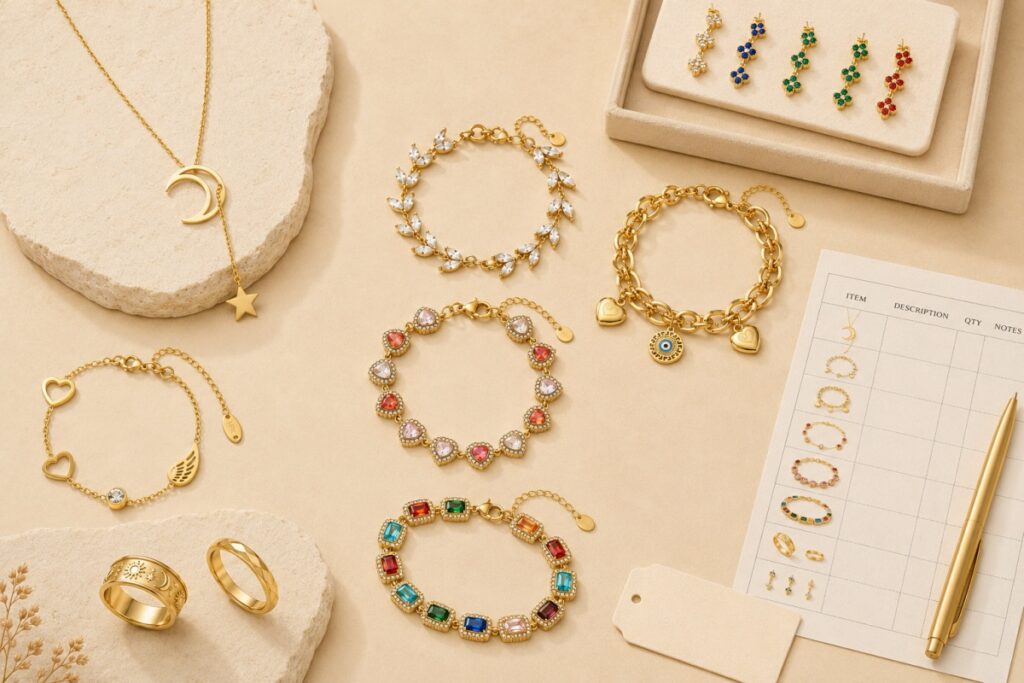
Buying wholesale stainless steel jewelry involves more than choosing attractive products from a catalog. Retailers need to consider customer preferences, product categories, order quantities, pricing, packaging, stock availability, quality consistency, and the ability to reorder successful styles.
A carefully planned wholesale order can help a boutique or online store test demand without creating unnecessary inventory pressure. An unbalanced order, however, may leave a retailer with too many similar products, limited price points, or styles that do not match the target customer.
This wholesale stainless steel jewelry buying guide explains how retailers, boutiques, online sellers, and growing jewelry brands can plan a practical first order and build a repeatable purchasing process.
1. Define Your Target Customer Before Selecting Products
Product selection should begin with the customer, not with the supplier’s full catalog. A large product range can be useful, but buying too many unrelated styles makes it harder to create a clear retail collection.
Before choosing products, define:
- The age group and lifestyle of your customers
- Their preferred jewelry styles
- The retail price range they are comfortable with
- The colors and finishes they usually buy
- Whether they prefer everyday jewelry or statement pieces
- Whether your store focuses on gifting, fashion, minimalism, or trend-led products
For example, a minimalist online store may focus on simple chains, small hoop earrings, slim rings, and polished bangles. A trend-focused boutique may prefer layered necklaces, bold bracelets, colorful stones, and statement earrings.
Your first wholesale order should reflect a recognizable customer profile rather than trying to cover every possible market.
2. Build a Balanced Jewelry Collection
A balanced collection gives customers several product categories while maintaining a consistent style direction. It also helps retailers test which categories perform best without placing an excessive quantity in one product type.
A mixed stainless steel jewelry collection may include:
- Wholesale stainless steel necklaces
- Wholesale stainless steel bracelets
- Wholesale stainless steel rings
- Wholesale stainless steel earrings
- Wholesale stainless steel bangles
The ideal category balance depends on your store. An online fashion retailer may need more earrings and necklaces because they are easy to display and purchase as gifts. A boutique with repeat local customers may benefit from a wider selection of rings, bracelets, and matching pieces.
Instead of selecting every product individually, consider building small groups that can be presented together:
- Minimalist gold-tone collection
- Silver-tone everyday collection
- Layered necklace collection
- Stackable ring and bangle collection
- Gift-friendly earring and pendant collection
This makes the assortment easier to photograph, market, display, and reorder.
3. Decide How Many Styles to Test
Need a custom assortment plan? If you’re unsure which styles will sell best in your boutique, we’re here to help. Our team works with hundreds of retailers to curate high-performance, low-MOQ mixed batches. Message us on WhatsApp with your shop’s niche, and we’ll send you a personalized style recommendation
A first order should be large enough to provide useful sales information but small enough to control inventory risk.
Retailers should consider:
- The available purchasing budget
- The number of product categories
- The number of finishes or colors
- The quantity required per SKU
- Expected monthly sales volume
- Available storage and display space
A common mistake is ordering many units of only a few untested styles. Another mistake is choosing too many SKUs with only one or two units of each, which may not provide enough stock for meaningful sales testing.
A more practical approach is to select a focused number of products and divide them into three groups:
- Core styles: simple products with broad customer appeal
- Trend styles: more distinctive products used to test current demand
- Collection builders: products that coordinate with other pieces
After the first selling period, retailers can increase quantities for proven styles and replace slower products with new designs.
4. Understand Stock-Supported and Made-to-Order Products
Existing-design wholesale products can usually be prepared faster than fully customized jewelry, but the phrase “in stock” should always be confirmed by SKU, color, size, and quantity.
Before placing an order, ask:
- Which styles are currently available?
- Which colors or sizes require replenishment?
- Can several products be combined in one order?
- How long does order preparation normally take?
- What happens if a selected style becomes unavailable?
Do not assume that every product displayed online is permanently available in unlimited quantities. Jewelry stock changes according to sales, production schedules, finishes, and order size.
Inoxara focuses primarily on existing stainless steel jewelry designs for wholesale buyers. Current stock, quantities, colors, and preparation times should be confirmed before payment.
5. Review Materials and Product Specifications
Two jewelry products may look similar in photographs but differ in weight, dimensions, steel grade, plating, construction, clasp type, or decorative components.
Before approving a product, review:
- Main material
- Surface finish or plating color
- Product dimensions
- Chain length
- Ring size or adjustable range
- Clasp, earring back, or closure type
- Stone, pearl, enamel, or other components
- Individual product weight where relevant
Retailers should avoid relying only on broad marketing claims. Statements related to waterproof performance, sensitivity, plating durability, or compliance should be confirmed according to the specific product and target market.
Close-up photographs, product videos, samples, and specification sheets can help buyers understand details that are difficult to judge from a catalog image.
6. Confirm MOQ and Mixed-Order Requirements
Minimum order quantity can be calculated in several ways. It may apply to each design, each color, each size, the total number of pieces, or the total order value.
Ask the supplier to explain whether the MOQ applies to:
- Each SKU
- Each plating color
- Each ring size
- Each product category
- The total mixed order
Mixed-item purchasing can be useful for retailers that want to test necklaces, bracelets, rings, earrings, and bangles in one order.
For Inoxara products currently available in stock, the standard wholesale MOQ is generally 50 pieces, and mixed-item orders can be supported. Exact requirements depend on the selected products, sizes, finishes, and current availability, so buyers should confirm the final order details before payment.
The lowest possible MOQ is not always the most economical option. Very small quantities may increase unit cost, packaging work, and shipping cost per item. The goal is to find a quantity that controls risk while maintaining a reasonable landed cost.
7. Calculate the Total Landed Cost
The quoted product price is only one part of the total purchasing cost. Retailers should calculate the landed cost before setting retail prices.
The landed cost may include:
- Product unit price
- Individual packaging
- Labels or barcodes
- Payment fees
- Inspection costs where applicable
- International shipping
- Import duties and taxes
- Local delivery
A product with a slightly higher unit price may still offer a better result if it has more consistent quality, lower defect risk, suitable packaging, and more reliable replenishment.
Retail pricing should also allow room for:
- Sales promotions
- Marketplace fees
- Payment processing
- Returns or replacements
- Marketing and photography
- Business operating costs
Compare suppliers based on total cost and expected retail margin, not only on the lowest quotation.
8. Consider Samples or a Trial Order
Samples can be useful when product size, finish, weight, color, or construction is important to your buying decision. A trial wholesale order can provide even more information because it allows you to evaluate the complete purchasing process.
A trial order helps retailers review:
- Product consistency across several units
- Packaging quality
- Order preparation time
- Communication
- Shipping performance
- Customer response after launch
When reviewing samples or trial products, compare them under normal lighting and test the parts that customers will handle most often.
Open and close clasps, check chain connections, inspect earring posts, examine ring surfaces, and compare the finish across multiple units of the same product.
9. Use a Practical Jewelry Quality Checklist
Wholesale quality control should focus on consistency and function, not only on whether one sample looks attractive.
Check the following areas:
- Visible scratches, dents, or marks
- Plating and color consistency
- Clasp and closure function
- Chain and connection strength
- Stone or decorative component security
- Welding and joining points
- Correct dimensions and sizes
- Correct quantities
- Packaging accuracy
For rings, check size consistency and surface finish. For earrings, check posts, backs, hinges, and pairs. For necklaces and bracelets, inspect clasps, jump rings, extension chains, and connection points.
Ask the supplier how confirmed defects, shortages, or incorrect products are handled. A clear after-sales process is part of the total wholesale service.
Quality control is the core of a sustainable jewelry business. To help our partners ensure perfection, we’ve developed a standardized 3-step inspection process—covering plating, clasp functionality, and surface finishing—for every batch we dispatch.
Message us on WhatsApp and I’ll send you our internal ‘Jewelry Quality Inspection Checklist’. You can use it to verify your goods, whether you’re working with us or any other manufacturer
10. Choose Packaging That Matches Your Sales Channel
Packaging requirements vary between boutiques, online stores, marketplaces, distributors, and private-label brands.
Basic wholesale packaging may include:
- Protective bags
- Jewelry cards
- Simple pouches
- SKU labels
- Barcode labels
- Inner and outer cartons
Retail-ready packaging may require additional cards, boxes, branded labels, or printed materials. These options can involve additional quantities, costs, and preparation time.
Retailers purchasing existing designs can begin with practical standard packaging and upgrade to private-label packaging after identifying their best-selling products.
11. Confirm Preparation Time and Shipping
Order timing should be divided into clear stages. A supplier’s processing time is not the same as the total time required for delivery.
The complete schedule may include:
- Product and stock confirmation
- Payment confirmation
- Order preparation
- Quality inspection
- Packaging
- Export handling
- International transport
- Customs clearance
- Local delivery
If products are required for a holiday, seasonal launch, trade event, or promotional campaign, allow additional time for possible delays.
Ask for a written timeline and confirm whether the shipping quotation is based on express delivery, air freight, sea freight, or another method.
12. Create a Reorder Plan
A successful wholesale buying process does not end when the first order arrives. Retailers should track product performance and use actual sales data to guide reorders.
Record information such as:
- Sales by SKU
- Sales by category
- Sales by finish or color
- Customer questions and feedback
- Return or defect reasons
- Average time required to sell through stock
Products can then be divided into:
- Reorder immediately: proven products with stable demand
- Monitor: products that sell gradually but support the collection
- Replace: slow-moving products with limited customer interest
Reordering proven products in larger quantities can improve purchasing efficiency, while continuing to add a controlled number of new styles keeps the collection fresh.
Common Wholesale Jewelry Buying Mistakes
Retailers can reduce purchasing risk by avoiding these common mistakes:
- Choosing products without defining the target customer
- Buying too many similar styles
- Comparing suppliers only by unit price
- Ignoring packaging and shipping costs
- Assuming every catalog product is always in stock
- Ordering large quantities before testing demand
- Failing to confirm sizes, colors, and specifications
- Not planning future reorders
Retailers should also evaluate the supplier itself before placing an order. For more information, read our guide on how to choose a wholesale stainless steel jewelry supplier.
Wholesale Jewelry Buying Checklist
| Buying Area | What to Confirm |
|---|---|
| Target Customer | Style, price range, age group, and sales channel |
| Product Mix | Categories, finishes, core styles, and trend styles |
| Availability | Current stock by SKU, size, color, and quantity |
| MOQ | MOQ per SKU, color, size, or mixed order |
| Specifications | Material, dimensions, finish, clasp, and components |
| Total Cost | Products, packaging, shipping, duties, and fees |
| Quality | Surface, color, connections, function, and quantity |
| Packaging | Protective, retail-ready, labeling, and carton requirements |
| Timeline | Preparation, inspection, shipping, and delivery time |
| Reorders | Restock availability and performance tracking |
Frequently Asked Questions
What jewelry categories should a retailer include in a first wholesale order?
A first order can include a balanced combination of necklaces, bracelets, rings, earrings, and bangles. The final mix should reflect the retailer’s target customer, sales channel, budget, and available display space.
Can different jewelry styles be combined in one wholesale order?
Mixed-item orders may be supported, but requirements can vary by supplier, SKU, finish, and size. Inoxara generally supports mixed-item orders for stock-supported products, subject to current availability and final order confirmation.
What is the wholesale MOQ for stainless steel jewelry?
MOQ varies by supplier and product. For Inoxara items currently available in stock, the standard MOQ is generally 50 pieces. Some products, finishes, sizes, or special requirements may have different quantities.
Should retailers order samples before placing a wholesale order?
Samples are useful when buyers need to check dimensions, finish, weight, construction, packaging, or product suitability. A small trial wholesale order can also provide useful information about quality consistency and customer demand.
How should retailers decide which products to reorder?
Track sales by SKU, category, finish, customer feedback, return reasons, and sell-through time. Reorder proven products, monitor collection-supporting styles, and replace products that show consistently weak demand.
Final Thoughts
A successful wholesale stainless steel jewelry order begins with a clear understanding of the target customer. Retailers should build a balanced assortment, confirm specifications and availability, calculate the full landed cost, inspect quality, choose practical packaging, and plan future reorders.
Start with a focused collection, collect real sales data, and gradually increase quantities for products that perform well. This approach helps retailers grow their jewelry range while controlling inventory risk.
Build Your Wholesale Jewelry Collection
Explore Inoxara’s existing stainless steel jewelry selections or contact us to confirm current products, mixed-order quantities, packaging options, and preparation times.
For more practical assortment planning, read our stainless steel bracelet assortment guide. Retailers comparing stock availability, order quantities and replenishment options can also refer to our ready stock stainless steel jewelry buying guide.