
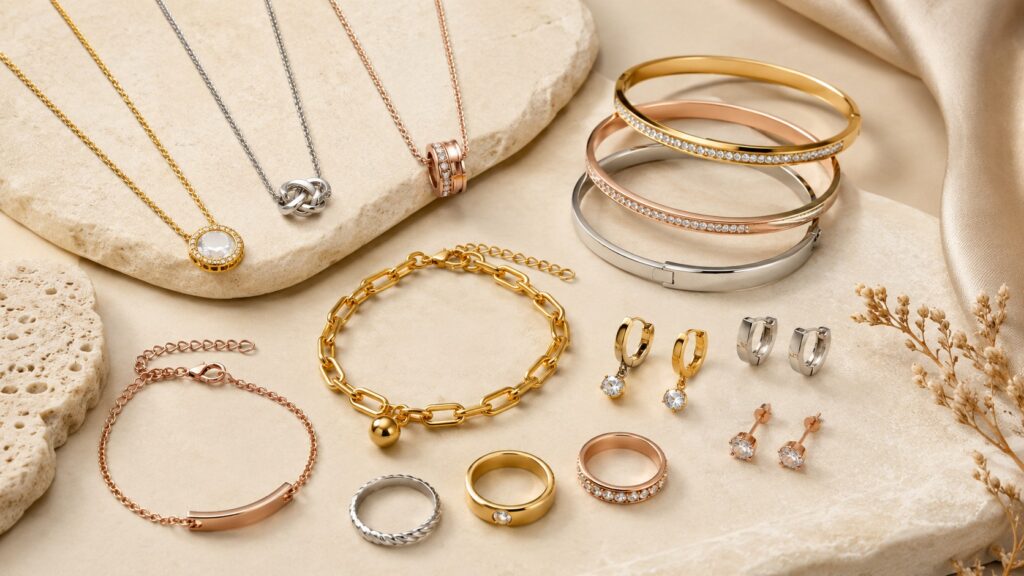
Choosing a wholesale stainless steel jewelry supplier requires more than reviewing a product catalog. Jewelry brands, wholesalers, boutiques and online retailers should evaluate product relevance, specifications, availability, quality consistency, packaging, order planning, delivery and long-term supply support.
A suitable supplier should be able to provide accurate product information, confirm current availability and coordinate each order according to the buyer’s commercial and quality requirements. The objective is to establish a reliable sourcing process that can support both current purchasing needs and future collection continuity.
What Does a Wholesale Jewelry Supplier Support?
A wholesale supplier helps buyers select existing products, confirm specifications, organize product quantities, prepare packaging and arrange shipment. When the supplier also has its own factory, it may be able to provide additional support for product adjustments, engraving, custom finishes and OEM/ODM development.
Wholesale supply support may include:
- Existing product selection
- Product and SKU information
- Material and finish confirmation
- Current availability checks
- Color and size allocation
- Sample evaluation
- Packaging and labeling
- Quality inspection
- Shipment preparation
- Reorder and collection continuity
Buyers should confirm which services apply to existing products and which requirements need a separate custom production project.
1. Define Your Product and Sourcing Requirements
Before contacting a supplier, buyers should define the product categories and commercial requirements of the collection. Clear information helps the supplier recommend relevant products and prepare a more accurate response.
Important questions include:
- Which jewelry categories are required?
- What design direction should the collection follow?
- Which plating colors are needed?
- Are specific ring sizes or product lengths required?
- Will the products use standard or branded packaging?
- Is engraving, logo tagging or other customization needed?
- What is the expected quantity for each product?
- What is the destination country or region?
A supplier can evaluate the request more efficiently when the buyer provides selected product links, SKUs, reference images and a clear quantity breakdown.
2. Evaluate the Product Range
A large catalog is not automatically better than a relevant product range. The supplier should offer products that match the buyer’s target customer, retail positioning and collection direction.
When evaluating the product selection, check whether it includes:
- Relevant product categories
- Consistent design directions
- Coordinating necklaces, bracelets, rings and bangles
- Suitable plating colors and surface finishes
- Core and signature product styles
- Clear product images and specifications
- Options that can support future collection development
Buyers can browse Inoxara’s stainless steel jewelry products, including existing necklaces, bracelets, rings, earrings and bangles for wholesale selection.
3. Check Whether Products Form a Consistent Assortment
Wholesale buying should be approached as collection planning rather than selecting unrelated individual products. The supplier should be able to help buyers confirm whether the chosen products work together in terms of category, scale, finish and retail positioning.
A coordinated assortment may use:
- Consistent plating colors
- Related chain or link structures
- Repeated geometric or decorative motifs
- Balanced product proportions
- Coordinated pendant, bracelet and ring designs
- Unified jewelry cards or packaging
For a structured planning approach, review our guide on building a balanced wholesale stainless steel jewelry assortment.
4. Verify Product Specifications
Accurate specifications are essential for comparing products and confirming an order. Product photographs alone cannot show material grade, dimensions, weight, closure type or component details.
Depending on the product category, buyers should confirm:
- Stainless steel grade
- Product dimensions and thickness
- Chain length and extension length
- Bracelet and bangle dimensions
- Ring size range
- Product weight
- Clasp, closure or backing type
- Stone, enamel or decorative components
- Plating color and surface finish
Most Inoxara ready-stock jewelry styles are made from 304 stainless steel. For selected custom projects, 316 or 316L stainless steel may also be discussed according to the product design and production requirements.
Buyers can review our 304 vs 316L stainless steel jewelry guide for additional material information.
5. Confirm Current Availability
Products shown on a wholesale website may vary in availability according to SKU, color, size and required quantity. Buyers should not assume that every product is available in every variation without confirmation.
Before finalizing an order, ask the supplier to confirm:
- The selected product SKU
- Available plating colors
- Available sizes or lengths
- The quantity required for each variation
- Whether replenishment or production is needed
- The expected preparation schedule
A written product list helps both parties confirm the correct styles, quantities, colors and specifications before payment or order preparation.
For more guidance on stock confirmation, mixed-style orders and preparation planning, read our ready-stock stainless steel jewelry wholesale guide.
6. Review Product Images, Videos and Samples
Clear product information helps buyers evaluate appearance and construction before confirming a wholesale order. Close-up images and videos may show surface finishing, clasp function, chain movement, stone placement and product scale more clearly than a single catalog photograph.
A physical sample may be useful when the buyer needs to confirm:
- Product dimensions and weight
- Surface finish and plating color
- Clasp or closure function
- Chain and connection strength
- Stone or component placement
- Wearability and overall appearance
- Packaging fit and presentation
Samples should be evaluated against the expected bulk requirements. Buyers can use our jewelry sample inspection checklist to record the product details that need to remain consistent.
7. Evaluate Quality-Control Standards
Wholesale buyers require consistent quality across multiple products and units. The supplier should explain how products are inspected and which details are checked before shipment.
Quality-control points may include:
- Product shape and dimensions
- Surface scratches and visible marks
- Polishing and edge finishing
- Plating color consistency
- Clasp and closure function
- Chain and connection points
- Welding quality
- Stone or decorative component security
- Logo and engraving accuracy
- Quantity, color and size allocation
- Packaging and label accuracy
Inoxara’s own factory team inspects stainless steel jewelry before shipment according to the confirmed product and order requirements.
8. Confirm the Difference Between Existing Products and Custom Production
Existing wholesale products and custom jewelry projects follow different sourcing and production routes.
| Order Route | Main Purpose | Requirements to Confirm |
|---|---|---|
| Existing product supply | Selecting available jewelry styles | SKU, color, size, quantity, packaging and preparation schedule |
| Existing products with branding | Adding engraving, logo tags or branded packaging | Artwork, branding position, processing and packaging requirements |
| Product adjustment | Changing dimensions, finish or selected details | Technical feasibility, samples and production planning |
| OEM/ODM production | Developing a new or coordinated product collection | Design, material, tooling, sampling, quality standards and bulk production |
Buyers requiring new structures, custom materials or broader product development can review our OEM/ODM jewelry manufacturing services.
9. Understand Applicable Order Requirements
Order requirements should be evaluated according to the selected product, material, finish, size allocation, branding, packaging and production route. A single general quantity should not be assumed for every product or project.
Buyers should provide:
- The required quantity for each SKU
- Color and size allocation
- Material requirements
- Branding or engraving details
- Packaging requirements
- The expected purchasing schedule
The supplier can then confirm applicable order requirements based on current product availability and the processing needed for the selected products.
10. Review Packaging and Labeling Support
Packaging affects product protection, inventory management and retail presentation. Buyers should confirm both the standard packaging and any optional branded packaging before the order is finalized.
Packaging options may include:
- Transparent protective bags
- Logo jewelry cards
- Jewelry pouches
- Branded gift boxes
- Barcode labels
- SKU and product labels
- Care and product information cards
Standard ready-stock packaging is normally different from custom private label packaging. Branded packaging requires separate confirmation of dimensions, materials, logo artwork, printing and production requirements.
Learn more about Inoxara’s private label jewelry packaging services.
11. Confirm the Quotation Scope
A professional quotation should clearly identify the products and services being discussed. Buyers should confirm what is included rather than comparing only one figure.
The quotation or order confirmation may need to identify:
- Product SKU and description
- Material and plating finish
- Color and size allocation
- Product quantity
- Standard or custom packaging
- Logo, engraving or additional processing
- Sample or tooling requirements
- Shipment terms
- Payment terms
- Estimated preparation or production schedule
Specifications, quantities and commercial terms should be confirmed in writing before payment and order preparation.
12. Review Processing and Delivery Planning
Processing time and transportation time are separate stages. Buyers should ask the supplier to clarify when the order is expected to be prepared and which shipping method will be used.
The complete schedule may include:
- Product and availability confirmation
- Order and payment confirmation
- Product preparation or production
- Quality inspection
- Packaging and labeling
- Export handling
- International transportation
- Customs clearance and local delivery
For product launches, retail campaigns or planned replenishment, buyers should provide the expected delivery schedule as early as possible.
13. Verify Commercial and Export Documentation
International wholesale transactions require accurate commercial information. Buyers should confirm that the supplier can provide the documents required for payment, shipment and customs clearance.
Depending on the order and destination, documents may include:
- Proforma invoice
- Commercial invoice
- Packing list
- Product and carton information
- Shipping documents
- Company payment details
Payment should be made only to the officially confirmed company account shown in the supplier’s commercial documents.
14. Evaluate Communication and Order Accuracy
Reliable communication is essential for wholesale sourcing. Fast replies are useful, but accurate and complete replies are more important.
A suitable supplier should be able to:
- Confirm uncertain information with the product or factory team
- Provide clear product and availability details
- Record approved specifications
- Identify differences between existing and custom products
- Confirm changes before order preparation
- Provide updates when availability or scheduling changes
Important product specifications, quantities, packaging and timelines should remain documented throughout the order process.
15. Plan for Reorders and Long-Term Supply
A wholesale relationship should support collection continuity and future purchasing. Buyers should maintain accurate product records so that proven products can be identified and reordered correctly.
Useful reorder information includes:
- Product SKU and reference image
- Material and finish
- Color and size allocation
- Previous order specifications
- Packaging and label details
- Approved logo artwork
- Inspection records
Before a reorder, availability and specifications should be reconfirmed because products, components and production schedules may change over time.
Wholesale Jewelry Supplier Evaluation Checklist
| Evaluation Area | What to Confirm |
|---|---|
| Product Range | Relevant categories, styles, colors and collection compatibility |
| Specifications | Material, dimensions, finish, components and size information |
| Availability | Current SKU, color, size and quantity availability |
| Quality Control | Inspection standards for appearance, function and packaging |
| Order Planning | Applicable requirements based on product and processing details |
| Packaging | Standard packaging, private label options and label accuracy |
| Delivery | Preparation, inspection, shipment and transportation schedule |
| Documentation | Invoices, packing lists, payment details and shipping documents |
| Communication | Specification confirmation, written records and order updates |
| Reorders | Product records, availability confirmation and collection continuity |
Frequently Asked Questions
What should I ask a wholesale stainless steel jewelry supplier?
Ask about product specifications, current availability, material, plating, quality control, applicable order requirements, packaging, preparation time, payment terms, shipping and documentation.
Are all products shown online always available?
Not necessarily. Availability can change according to SKU, color, size, quantity and replenishment schedule. Buyers should request current confirmation before finalizing an order.
Can existing jewelry products include branding?
Selected existing products may support engraving, logo tags or private label packaging. Feasibility depends on the product structure, artwork, processing and order requirements.
Should samples be checked before wholesale purchasing?
Samples are useful when buyers need to confirm dimensions, weight, finish, function, packaging or quality requirements before organizing a broader order.
Does Inoxara have its own factory?
Yes. Inoxara has its own stainless steel jewelry factory, supporting existing product supply, sample development, engraving, OEM/ODM manufacturing, quality inspection and optional private label packaging.
Work with Inoxara as Your Wholesale Jewelry Supplier
Inoxara supplies stainless steel jewelry for brands, wholesalers, boutiques, online retailers and private label projects. Buyers can select existing products or discuss additional processing and custom development according to their project requirements.
Our own factory team supports product evaluation, sample development, plating, engraving, inspection and packaging. We confirm product availability and applicable order details according to the selected SKUs, specifications and required quantities.
Send us your selected product links or SKUs, expected quantities, colors, sizes, packaging requirements and delivery destination. Our team will review the complete request and confirm the appropriate sourcing solution.