
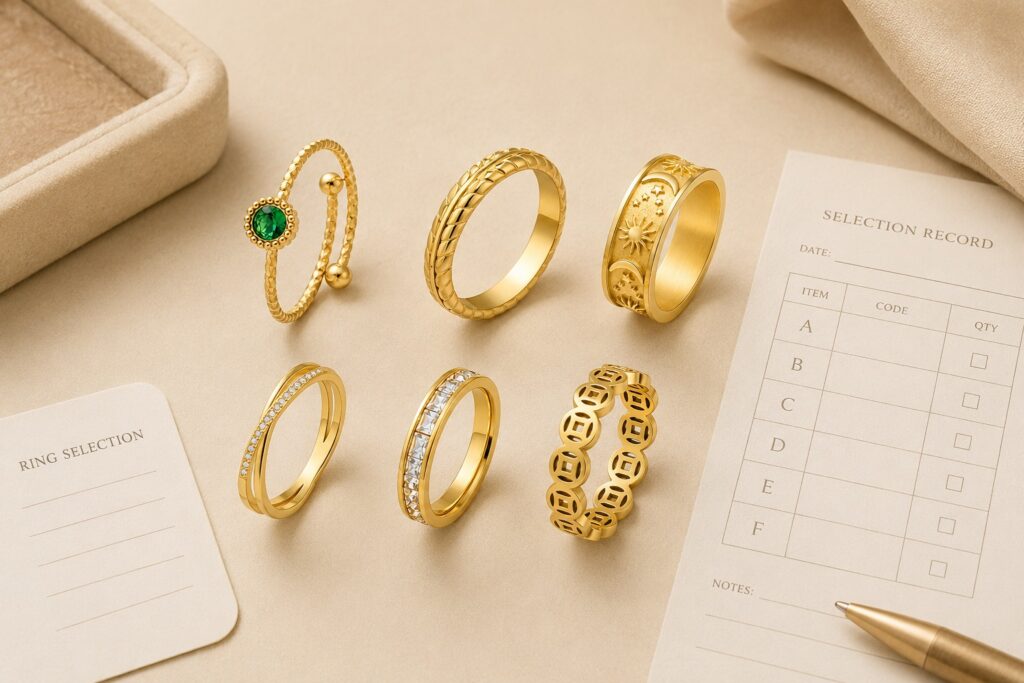
This stainless steel ring assortment guide helps retailers, boutiques and wholesale buyers plan a balanced selection of minimalist bands, stone rings, stackable styles, adjustable rings and statement designs.
A practical ring collection requires more than choosing attractive products. Buyers also need to consider customer preferences, ring sizes, finishes, stone colors, price points, product presentation and future reorder potential without creating unnecessary inventory pressure.
1. Define the Target Customer Before Selecting Rings
The right ring assortment depends on the customers a store wants to serve. A minimalist jewelry brand may focus on simple bands and small stone rings, while a fashion boutique may need bold shapes, colorful stones and stackable designs.
Before placing a wholesale ring order, consider:
- The customer’s preferred style and age group
- Whether the rings are intended for daily wear, gifting or fashion styling
- The preferred retail price range
- Whether customers mainly choose gold-tone, silver-tone or mixed finishes
- Whether the store needs fixed-size rings, open rings or adjustable designs
- Whether rings will be sold individually or as coordinated collections
A clear customer profile helps buyers avoid selecting too many unrelated styles.
2. Build a Balanced Stainless Steel Ring Assortment
A balanced collection should include several ring types rather than relying on one design direction.
Minimalist Band Rings
Simple polished bands, narrow rings and small geometric details are suitable for everyday collections. These styles are easy to combine with bracelets, necklaces and earrings.
Stone Rings
Clear CZ, colored stones and small decorative settings can add visual variety without making the collection difficult to manage. Buyers should inspect the stone setting, surface finish and overall balance of each design.
Stackable Rings
Thin bands, textured rings and small stone styles can be worn separately or combined. Stackable rings allow retailers to create coordinated sets and encourage multiple-item purchases.
Statement Rings
Wide bands, sculptural shapes, larger stones and bold motifs are useful for fashion-focused collections. These designs should normally represent a smaller part of the first order until customer demand is confirmed.
Open and Adjustable Rings
Open-ring designs can reduce some sizing pressure, but buyers should still confirm the supported size range, structure and wearing comfort. Not every open ring is suitable for repeated adjustment.
Retailers can explore Inoxara’s existing wholesale stainless steel rings when planning a mixed assortment.
3. Balance Everyday Rings and Test Styles
The opening order should include dependable everyday products while leaving room to test new designs.
An example assortment may include:
- 35% minimalist band rings
- 25% small stone rings
- 15% stackable styles
- 15% open or adjustable rings
- 10% statement or seasonal test styles
This ratio is only a planning example. The final selection should be adjusted according to the retailer’s audience, sales channel and existing product data.
New retailers should avoid placing large quantities on untested statement rings. Smaller test quantities make it easier to identify which styles deserve future reorders.
4. Plan Ring Sizes Carefully
Ring sizing is one of the most important parts of assortment planning. Buyers should confirm whether each style is available in fixed sizes, open sizes or adjustable structures.
For fixed-size rings, consider:
- The most common sizes requested by the target market
- Whether the same style is available across several sizes
- How many pieces should be allocated to each size
- Whether the supplier can support future size-based reorders
- Whether size labels or packaging identification are available
For open rings, buyers should confirm the recommended wearing range instead of assuming that one ring will fit every customer.
Retailers should also record sales by size. This helps reduce overstock in slow-moving sizes and improves future order planning.
5. Balance Gold-Tone, Silver-Tone and Stone Colors
Offering too many finishes and stone colors in the first order can create unnecessary inventory pressure. Buyers should begin with the combinations most relevant to their customers.
A practical starting selection may include:
- Gold-tone rings for fashion and gift-focused collections
- Silver-tone rings for minimalist and everyday collections
- Clear CZ rings for versatile retail assortments
- Selected colored stones for seasonal or coordinated collections
- A limited number of black, rose gold or mixed-color test styles
When the structure is identical and only the plating or stone color changes, the variations should normally remain on one product page. This makes it easier for buyers to compare options and keeps the website organized.
6. Check Material, Plating and Ring Construction
Wholesale buyers should review the product specifications rather than relying only on photographs.
Important details include:
- Stainless steel grade
- Plating color and finishing process
- Ring width and thickness
- Fixed-size, open or adjustable structure
- Stone setting and edge finish
- Surface polishing and visible scratches
- Available sizes, colors and reorder consistency
For Inoxara’s regular stock items, 304 stainless steel is commonly used. 316L stainless steel may be evaluated for selected custom orders depending on the design, production process and order requirements.
7. Use Samples to Check Ring Quality
Samples help retailers evaluate construction, appearance and wearing comfort before increasing quantities.
A basic ring sample inspection should include:
- Checking the surface for scratches, dents or uneven polishing
- Inspecting the plating for visible color differences
- Confirming that stones are secure and evenly positioned
- Checking whether the ring edges feel smooth
- Comparing the actual ring size with the stated measurement
- Testing the structure of open or adjustable rings carefully
- Comparing the physical product with the supplied images
- Checking labels, packaging and product-card presentation
Retailers should also photograph the samples using their normal content style. Rings with clear details and consistent finishes are generally easier to present online.
8. Organize Rings Into Coordinated Collections
Instead of presenting every ring as an unrelated product, retailers can group them into small collections.
Examples include:
- Minimalist gold-tone band collection
- Silver-tone everyday ring collection
- Clear CZ gift collection
- Colorful stone ring collection
- Celestial moon and star collection
- Stackable ring collection
- Wide-band statement collection
Coordinated ring groups make product photography, store displays, social media campaigns and customer recommendations easier to manage.
9. Keep the First Wholesale Ring Order Manageable
A large catalog does not require retailers to order every available ring style, size and color. A focused selection is usually easier to evaluate, display and reorder.
Selected ready-stock styles may start from 50 pieces, while the exact quantity depends on product availability, size distribution, color selection and order composition.
Before confirming the order, buyers should ask:
- Can different ring styles be mixed?
- Can sizes be mixed within one order?
- Which sizes and colors are currently available?
- How are sizes identified during packing?
- Can strong-selling sizes be reordered separately?
- What is the estimated preparation time?
For broader assortment planning, read our wholesale stainless steel jewelry buying guide for retailers.
Buyers comparing stock availability, order quantities and replenishment options can also review our ready-stock stainless steel jewelry wholesale guide.
10. Plan Ring Reorders Using Sales Data
The first wholesale order should be treated as a test rather than a final assortment. Retailers should track:
- Sales by ring style
- Performance by ring size
- Gold-tone and silver-tone demand
- Customer requests for specific sizes or stone colors
- Products frequently purchased as gifts
- Styles that receive attention but few purchases
- Rings that sell well as coordinated sets
Strong-selling sizes and designs can receive larger reorder quantities, while slow-moving styles can be replaced with new test products.
Common Ring Assortment Mistakes
- Ordering too many similar band styles
- Ignoring ring size distribution
- Assuming open rings fit every customer
- Offering too many colors before testing demand
- Buying large quantities before checking samples
- Failing to inspect stone settings and ring edges
- Choosing products only by unit price
- Not recording sales by size and style
- Failing to confirm future reorder availability
Final Thoughts
A practical stainless steel ring assortment combines minimalist bands, stone rings, stackable designs, open rings and a limited number of statement styles.
Retailers should begin with a focused collection, confirm sizes and specifications, inspect samples and use real sales data to guide future reorders. This approach helps reduce inventory risk while building a ring selection that is easier to display, photograph, market and replenish.
Build Your Stainless Steel Ring Collection
Browse Inoxara’s existing ring styles or contact us to confirm available products, sizes, stone colors, mixed-order quantities, packaging options and preparation times.
Brands requiring new ring designs, custom sizes, logo development, plating colors or branded packaging can also review our custom jewelry services.