
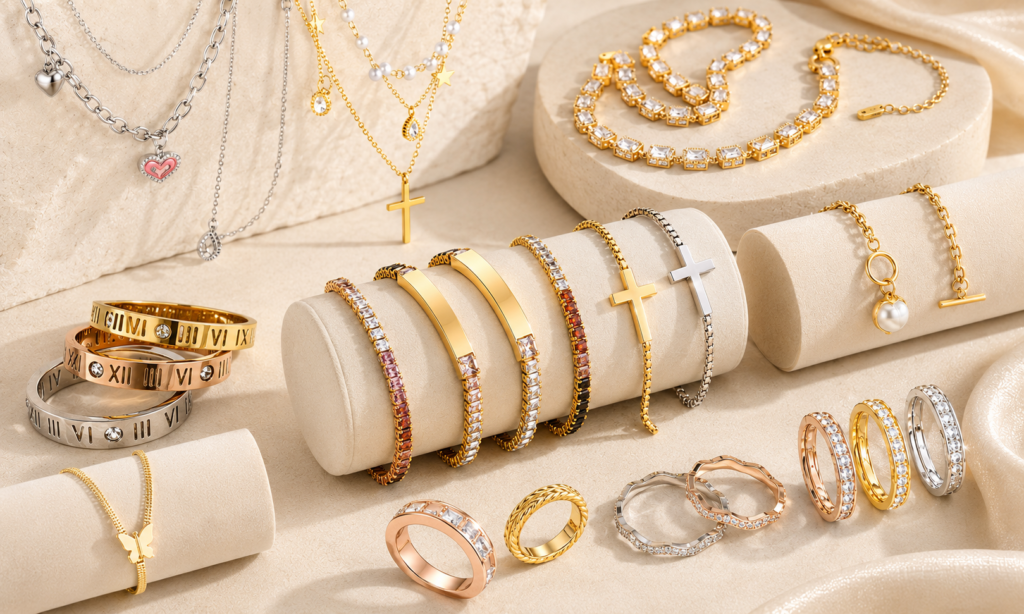
304 vs 316L stainless steel jewelry is an important material comparison for jewelry brands, wholesalers, boutiques and private label businesses. Both materials are widely used for necklaces, bracelets, rings, earrings and custom jewelry, but they have different advantages depending on product style, target market, budget and customization requirements.
Understanding the difference between 304 and 316L stainless steel can help buyers choose the right material for ready-stock wholesale styles, premium custom orders, plating projects and private label jewelry collections.
At Inoxara, many regular ready-stock stainless steel jewelry styles are based on practical wholesale supply needs, while 316L stainless steel can be discussed for selected custom, premium or close-to-skin jewelry projects. Buyers can first browse our ready-stock stainless steel jewelry products, then confirm suitable material, plating color, quantity and packaging requirements before ordering.
What Is 304 Stainless Steel Jewelry?
304 stainless steel is a common stainless steel material used in many jewelry and accessory products. It is durable, cost-effective and suitable for many regular stainless steel jewelry styles.
For wholesale jewelry projects, 304 stainless steel can be a practical choice when buyers need stable quality, competitive pricing and a wide range of available styles. It is often used for fashion jewelry collections, boutique styles, promotional products and daily wear accessories.
For buyers who want to test new products with lower development pressure, 304 stainless steel can be suitable for many ready-stock styles, including stainless steel necklaces, stainless steel bracelets, stainless steel rings, stainless steel earrings and stainless steel bangles.
For many wholesale buyers, the 304 vs 316L stainless steel jewelry decision depends on whether the collection is focused on cost-effective ready-stock styles or premium custom product development.
What Is 316L Stainless Steel Jewelry?
316L stainless steel is often selected for higher-quality jewelry projects. It has stronger corrosion resistance than 304 stainless steel and is commonly considered for jewelry that requires better material performance, especially products worn close to the skin.
For jewelry brands that focus on premium positioning, long-term wear and higher product quality, 316L stainless steel jewelry can be a stronger material option. It is commonly discussed for rings, necklaces, bracelets, earrings and private label jewelry collections with specific quality requirements.
Because 316L stainless steel usually involves higher material cost or different production planning, buyers should confirm MOQ, product structure, plating requirements and order quantity before starting a custom project. You can review our OEM/ODM custom jewelry service to understand available customization options.
304 vs 316L Stainless Steel Jewelry: Main Differences
The main difference between 304 and 316L stainless steel jewelry is material performance and cost. 304 stainless steel is usually more cost-effective, while 316L stainless steel provides stronger corrosion resistance and is often preferred for higher-quality jewelry projects.
If your brand focuses on price-sensitive wholesale styles, seasonal collections or ready-stock product testing, 304 stainless steel may be suitable for many products. If your brand focuses on premium quality, long-term wear, custom collections or close-to-skin jewelry, 316L stainless steel may be a better choice.
For many B2B buyers, the practical approach is not choosing one material for every product. Instead, buyers can use 304 stainless steel for regular wholesale styles and consider 316L stainless steel for selected premium, custom or private label items.
Which Material Is Better for Necklaces?
For stainless steel necklaces, both 304 and 316L stainless steel can be used depending on the design and market positioning. Ready-stock necklace styles can often use 304 stainless steel for better cost control and faster product selection.
For custom necklaces, private label collections, premium pendant styles or products designed for long-term wear, 316L stainless steel can provide stronger product value and better brand positioning.
Buyers can review our wholesale stainless steel necklaces to compare available necklace styles, chain structures, pendant designs and plating options before confirming material requirements.
Which Material Is Better for Bracelets?
Bracelets are often exposed to daily friction, sweat and direct skin contact. For regular fashion bracelet collections, 304 stainless steel can be a practical and cost-effective option.
For premium bracelet lines, custom logo bracelets, stone bracelets, charm bracelets or private label jewelry collections, 316L stainless steel can be discussed when buyers want stronger material performance and improved product positioning.
For ready-stock wholesale selection, buyers can browse our wholesale stainless steel bracelets and confirm current colors, quantities, packaging options and customization requirements before ordering.
Which Material Is Better for Rings?
Rings are worn directly on the skin and often experience more daily contact than necklaces or bracelets. For this reason, many brands may prefer 316L stainless steel for premium ring collections, custom rings and private label ring projects.
304 stainless steel can still be used for some regular fashion ring styles, especially when buyers need competitive pricing and ready-stock product options. However, 316L stainless steel is often more suitable when product quality, long-term wear and brand positioning are more important.
Buyers can compare existing wholesale stainless steel rings first, then decide whether selected ring styles need upgraded material, engraving, logo details or private label packaging.
Which Material Is Better for Earrings and Bangles?
Earrings and bangles also need suitable material selection based on wearing position, product structure and market expectations. For regular fashion earrings and bangles, 304 stainless steel can be suitable for many wholesale styles.
For premium earrings, close-to-skin products or custom collections with higher quality requirements, 316L stainless steel can be discussed based on design, order quantity and production requirements.
Buyers can review our wholesale stainless steel earrings and wholesale stainless steel bangles to evaluate available product directions before confirming material and customization needs.
How Material Choice Affects Plating
Plating quality is an important part of stainless steel jewelry. Gold, silver, rose gold, black, two-tone and other plating options can be applied to stainless steel jewelry, but the final result depends on base material quality, surface treatment, polishing, plating process and quality control.
Before placing a bulk order, buyers should confirm the base material, plating color, surface finish and sample quality. This is especially important for jewelry brands that need consistent color and stable quality across different product styles.
For custom plating projects, buyers should also confirm whether the supplier can support the required color, finish, quantity and packaging. This is useful for brands that need coordinated necklaces, bracelets, rings and earrings in the same collection.
How to Choose the Right Material for Your Brand
The right material depends on your brand positioning, target price, product type and customer expectations. If you need cost-effective wholesale styles, 304 stainless steel may be enough for many products. If you want a more premium collection, 316L stainless steel jewelry can help improve product value.
When comparing 304 vs 316L stainless steel jewelry, buyers should consider product type, wearing position, plating requirements, customer expectations and target retail price.
For first-time orders, many buyers choose existing styles first, then upgrade selected products to 316L stainless steel for premium or private label collections. This can help control cost while testing market demand.
For example, a buyer may start with ready-stock stainless steel necklaces, bracelets and rings, then develop selected custom styles with specific plating colors, logo tags, engraving, jewelry cards or gift boxes after confirming the market response.
Sample Checking Before Bulk Orders
Sample checking is important when comparing 304 vs 316L stainless steel jewelry. A sample can help buyers review material feel, polishing, plating color, stone setting, size, edge finishing, engraving quality and packaging details before confirming a larger order.
Sample checking is especially useful when buyers are not sure which option is better in a 304 vs 316L stainless steel jewelry project.
For wholesale buyers and private label brands, sample inspection can reduce misunderstanding and improve product consistency. You can download our jewelry sample inspection checklist to help review stainless steel jewelry samples before bulk ordering.
Inoxara Stainless Steel Jewelry Material Support
Inoxara supports stainless steel jewelry projects for brands, boutiques, wholesalers and private label customers. We provide ready-stock stainless steel necklaces, bracelets, rings, earrings and bangles, with support for custom plating colors, logo tags, engraving, jewelry cards, gift boxes and OEM/ODM production.
For regular wholesale styles, we can help buyers choose suitable stainless steel material based on product type, budget, available stock and order requirements. For premium or close-to-skin jewelry projects, 316L stainless steel can also be discussed based on design, quantity and customization needs.
Buyers can browse our available stainless steel jewelry products first, or contact us with product references, target quantity, material preference, plating color and packaging requirements for further confirmation.
Conclusion: Choosing 304 vs 316L Stainless Steel Jewelry
There is no single answer for every 304 vs 316L stainless steel jewelry project. The right choice depends on product positioning, order quantity, quality expectations and customization needs.
Both 304 and 316L stainless steel can be used for jewelry, but they serve different needs. 304 stainless steel is suitable for many cost-effective wholesale styles, while 316L stainless steel is often better for premium jewelry, close-to-skin products and long-term brand collections.
If you are planning a stainless steel jewelry project, the best choice depends on your product type, target market, budget, customization requirements and brand positioning.
Explore our ready-stock stainless steel jewelry products, including wholesale stainless steel necklaces, wholesale stainless steel bracelets, wholesale stainless steel rings, wholesale stainless steel earrings and wholesale stainless steel bangles, or review our OEM/ODM custom jewelry service.